The question “how much does it cost to build an MVP?” sounds straightforward, but in practice it rarely is. Teams looking for a quick estimate often end up with ranges that are either too generic to be useful or too optimistic to hold once real constraints emerge.
In SaaS and fintech environments, MVP cost is shaped less by feature count and more by a set of early decisions: how clearly the problem is defined, how the system is structured, what needs to integrate with external services, and what regulatory requirements apply from day one. Two products with similar functionality can differ significantly in cost depending on these factors.
Much of the confusion around MVP pricing comes from treating cost as a fixed benchmark rather than an outcome of these decisions. That pattern shows up consistently across products built in different domains and at different stages of maturity.
This perspective is based on over 15 years of building digital products across early-stage and scaling environments, where initial estimates often diverge from actual costs for the same underlying reasons.
This article looks at MVP cost from that angle. Instead of focusing only on price ranges, it breaks down the decisions and constraints that actually drive cost, how they show up across different product types, and how to approach budgeting in a way that aligns with validation and long-term scalability.
Why most MVP cost estimates fail in SaaS and Fintech
A large share of MVP cost estimates are built on incomplete information. At an early stage, that is expected, but the issue is how those gaps are handled. Estimates are often presented as fixed ranges, while the underlying variables remain undefined.
This matters because software budgets fail differently from other budgets. A study of 11,011 projects across 23 project types, published in the Project Management Journal by Bent Flyvbjerg and colleagues, found IT was the only category with a Pareto tail parameter below one, at 0.92. In plain terms, the distribution of IT cost overruns has no finite mean, so conventional forecasting does not work on it.
The shape of that risk matters more than the average. Most software projects land close to their number. The base rate of ending up in the tail is 18.26%, and for the projects that get there the average overrun is 453%. The danger is not that every build runs over. It is that the ones which do run over do so without a ceiling. In early-stage products the mechanism is usually the same: when the problem is not clearly defined, teams overbuild instead of validating, and scope expands to absorb uncertainty rather than to serve users.
Another source of error is underestimating system complexity:
- data modeling and consistency
- interactions between services
- handling edge cases and failure scenarios
This becomes more pronounced in SaaS and fintech. Technology startups, for example, see failure rates above 60% within five years, often driven by execution and scaling challenges rather than idea quality.
Integrations are another frequent blind spot. Early estimates may assume that connecting to a payment provider, identity service, or external API is straightforward. In reality, these integrations introduce:
- variability in implementation effort
- dependency on third-party reliability
- additional testing and error handling
In regulated environments, compliance and security requirements further complicate estimates. Requirements related to data protection, auditability, or transaction traceability are rarely optional, and they influence both architecture and delivery timelines from the start.
Finally, estimates often fail because they assume a linear relationship between scope and cost. In practice, cost tends to increase non-linearly as:
- more integrations are added
- system boundaries become less clear
- coordination between components grows
What drives MVP cost
MVP cost is shaped by product clarity, architecture, integrations, and constraints.
1. Product clarity vs feature scope
Is cost driven by how much you build or how clearly you define what needs to be built?
Lack of clarity increases cost significantly. Well-defined problems lead to smaller, more focused MVPs.
In early-stage products, scope often expands to compensate for uncertainty. Instead of validating a core assumption, teams add additional flows, edge cases, or secondary features. This increases both build effort and coordination complexity.
Clear product definition allows teams to:
- isolate the core use case
- reduce unnecessary logic and dependencies
- shorten feedback cycles
2. Architecture decisions: monolith vs microservices
How does system architecture impact MVP cost and delivery speed?
Architecture choices introduce different levels of complexity and coordination overhead. Early-stage products rarely benefit from fully distributed systems. A common pattern is overinvesting in microservices too early. While distributed architectures support scalability, they introduce:
- service coordination overhead
- more complex deployment pipelines
- increased monitoring and failure handling
For most MVPs, a modular monolith provides a more cost-efficient starting point. It allows:
- faster iteration
- simpler debugging
- lower operational overhead
The key is not avoiding scalability, but deferring complexity until it is justified.
3. Integrations and external dependencies
How do third-party services affect MVP cost and timelines?
Integrations are one of the most underestimated cost drivers. Each dependency introduces variability and ongoing maintenance.
In SaaS and fintech products, MVPs rarely operate in isolation. Common dependencies include:
- payment providers
- identity and authentication services
- banking or financial data APIs
- communication and notification systems
Each integration adds:
- implementation complexity
- dependency on external reliability
- additional testing scenarios
4. Compliance, security, and data constraints
How do regulatory and data requirements influence MVP cost?
In regulated environments, compliance is not an add-on. It shapes architecture, data handling, and delivery from the start.
Fintech and similar domains require consideration of:
- data protection and encryption
- audit trails and traceability
- identity verification (KYC)
- transaction monitoring (AML)
These requirements introduce:
- additional backend logic
- stricter infrastructure choices
- more extensive testing and validation
5. Team composition and seniority
Does a larger or lower-cost team reduce MVP cost?
Cost efficiency comes from decision quality, not team size. Smaller, senior teams tend to reduce overall cost by avoiding rework.
Less experienced teams may:
- require more time to resolve ambiguity
- introduce inconsistencies in architecture
- generate additional coordination overhead
Senior teams, while higher in hourly rate, typically:
- make faster decisions
- anticipate edge cases earlier
- reduce iteration cycles
The result is often lower total cost despite higher nominal rates.
6. Delivery model and iteration speed
How does the development approach impact MVP cost?
Cost is controlled by how quickly teams can validate assumptions, not by how tightly scope is fixed upfront.
Iterative delivery models allow teams to:
- test assumptions early
- adjust scope based on feedback
- avoid building unnecessary features
In contrast, rigid, upfront planning tends to:
- lock in incorrect assumptions
- delay feedback
- increase the likelihood of rework
For MVPs, the ability to shorten feedback loops is one of the most important cost control mechanisms.
How product type influences MVP cost
At a high level, MVP costs are often discussed in terms of features or interfaces. In practice, the type of product you are building has a much stronger influence on where complexity emerges and how effort is distributed.
Mobile applications, for example, are frequently perceived as UI-heavy and therefore easier to estimate. In reality, the mobile layer is often the simplest part of the system. Most of the effort sits behind it, in backend services, APIs, and data synchronization. Cost increases when the app needs to support multiple platforms, handle real-time updates, or integrate with external systems. The decision to go native or cross-platform also affects both initial development effort and long-term maintenance.
Web platforms and portals tend to grow in complexity more gradually, which makes them harder to estimate early on. What starts as a simple interface often evolves into a system with multiple user roles, permissions, and workflows. Administrative panels, reporting layers, and internal tools are typically added as the product matures, but they introduce significant backend complexity from the beginning. In these cases, cost is driven less by frontend implementation and more by how data is structured, accessed, and managed across different user types.
SaaS products introduce a different category of complexity altogether. Even at MVP stage, there is usually a need to account for multi-tenancy, user lifecycle management, and some form of billing or subscription logic. These are not features that can be fully deferred, as they influence how the system is designed at a foundational level. Decisions around data isolation, access control, and scalability tend to appear earlier, which increases the baseline cost compared to more contained applications. Within the overall range set out below, SaaS products typically sit from the middle upward, because multi-tenancy, user lifecycle and billing logic cannot be fully deferred. The variance is less about feature count and more about architecture, integrations and regulatory constraints.
Across all three categories, the visible product surface can be misleading. Two MVPs may look similar from a user perspective but differ significantly in cost depending on what happens behind the interface. A mobile app backed by a simple service will have a very different cost profile than one relying on multiple integrations and real-time data processing. Similarly, a web platform with basic content management is not comparable to one handling complex workflows and permissions.
For cost estimation, this distinction matters. Product type is not just a label, it is an indicator of where complexity will concentrate.
MVP cost ranges are widely shared and often used as a starting point for planning. They provide a rough sense of scale, but on their own, they rarely reflect the realities of a specific product.
At a high level, most MVPs fall somewhere between $60,000 and $400,000, depending on product type and complexity. Simpler single-journey mobile or web products sit at the lower end. SaaS platforms with multi-tenancy sit from the middle upward. Integration-heavy or regulated products sit at the top, and occasionally above it. That range assumes a defined core scope, a straightforward data model, few external integrations and a small focused team over a bounded timeframe. Every one of those assumptions is worth checking against your own product before treating the number as a plan. Within that range, you’ll often see breakdowns such as:
- simpler mobile or web applications at the lower end
- more complex platforms and SaaS products at the higher end
These ranges can be directionally useful, but they tend to compress very different levels of complexity into the same buckets.
What matters more is understanding what these estimates assume.
In most cases, standard MVP cost ranges are based on:
- a limited number of core features
- relatively straightforward data models
- minimal external integrations
- a small, focused team working over a defined timeframe
They also typically assume that:
- requirements are stable enough to avoid major rework
- compliance requirements are limited or already defined
- infrastructure needs remain relatively simple in early stages
In practice, these assumptions do not always hold.
Many estimates exclude factors that significantly affect total cost, such as:
- integration with third-party systems (payments, identity, financial data)
- compliance-related work (security, auditability, regulatory constraints)
- production-grade infrastructure and monitoring
- iteration cycles driven by changing requirements or new insights
This is where the gap between estimated and actual cost tends to appear.
Another important aspect is how cost scales. MVP pricing is often presented as if complexity increases in a linear way, moving from “simple” to “complex” in predictable steps. In reality, cost tends to increase more sharply once certain thresholds are crossed, such as:
- introducing multiple integrations
- handling real-time or high-frequency data
- supporting multiple user roles with different permissions
- designing for early scalability
At that point, additional effort is required not just to build features, but to manage interactions between components and ensure system reliability.
For this reason, cost ranges are best treated as reference points rather than commitments. They help frame expectations, but they do not replace a deeper understanding of the product’s constraints and decisions. Which raises the obvious question: if a range is not a plan, what produces a number you can actually put in front of a board. That is the job of a structured design phase, four to six weeks that converts an idea into a scope with ranged estimates, a validated architecture and a release plan attached. It typically costs around a tenth of the build it precedes, and it is the mechanism by which a range becomes a commitment. We have written about why a product design phase comes before the build budget in detail.
MVP cost ranges explained with context
Instead of relying on static ranges, it is more useful to frame MVP cost across three dimensions:
1. Core build scope (baseline cost)
The effort required to implement the core user flow and supporting backend logic.
This is the part most estimates focus on.
2. System complexity (multiplier)
Factors that increase effort non-linearly, such as:
- number of integrations
- data model complexity
- real-time processing requirements
- number of user roles and workflows
As these increase, cost grows faster than scope alone would suggest.
3. Constraints (fixed overhead)
Requirements that must be addressed regardless of scope:
- compliance and security
- infrastructure and deployment
- reliability and monitoring
These often set a minimum cost threshold, especially in fintech and SaaS environments.
In practice, MVP cost can be understood as:
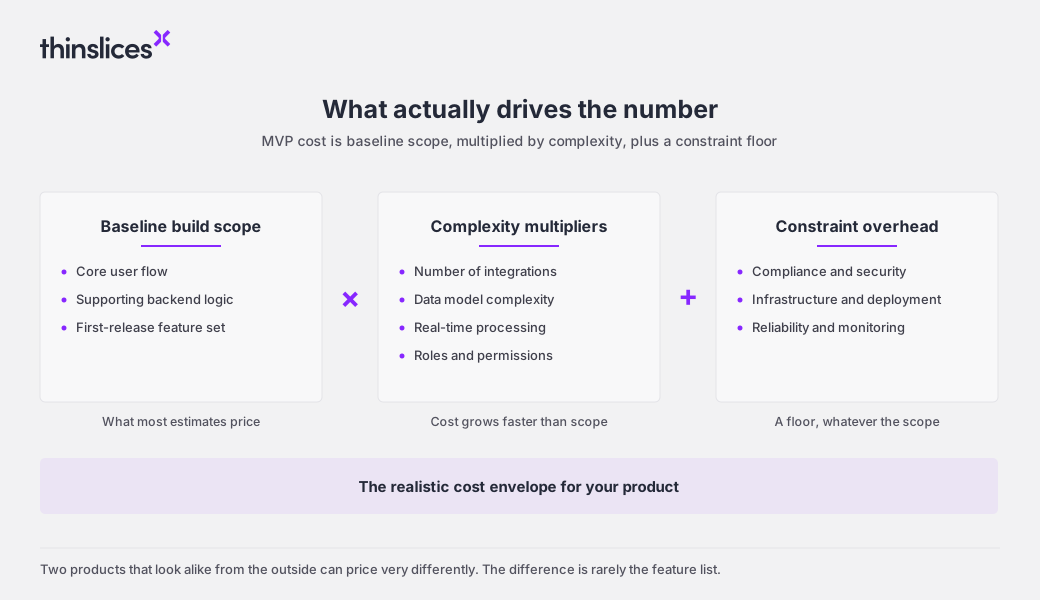
This framing does not produce a single number, but it provides a clearer way to evaluate whether an estimate reflects the realities of the product.
Hidden MVP costs that impact total investment
MVP planning tends to focus on build cost, but in practice, total investment is shaped just as much by what happens around and after delivery. Estimates are frequently off by a material margin, and the overrun rarely comes from the part anyone budgeted for. Infrastructure, integration maintenance and iteration driven by learning all land after the initial estimate is set, which is why the gap tends to appear at the point where the product first meets real usage.
One of the most common sources of additional cost is rework caused by early architectural decisions. Choices made to move quickly, such as tightly coupling components or skipping clear service boundaries, can create constraints that become difficult to work around as the product evolves. When new requirements emerge, teams may need to revisit core parts of the system rather than extending them, which increases both cost and timelines.
Infrastructure and operational overhead is another area that tends to be underestimated. Even a relatively simple MVP requires:
- environment setup (development, staging, production)
- deployment pipelines
- monitoring and logging
- basic reliability and recovery mechanisms
As soon as the product is used in a real environment, these concerns become essential rather than optional. In distributed or integration-heavy systems, operational complexity increases further due to the need to manage multiple services and dependencies.
Integration maintenance also introduces ongoing cost. While initial estimates usually account for connecting to external services, they rarely account for:
- changes in third-party APIs
- handling intermittent failures
- adapting to performance or rate limits
In fintech and SaaS products, where integrations are central to functionality, this becomes a continuous effort rather than a one-time task.
Another factor is coordination and delivery overhead. As team size grows or system complexity increases, more effort is required to:
- align on decisions
- manage dependencies between components
- maintain consistency across the codebase
This overhead does not directly produce features, but it affects delivery speed and therefore total cost.
Finally, there is the cost of iteration driven by learning. MVPs are built to validate assumptions, which means changes are expected. However, when the system is not designed to accommodate change, each iteration becomes more expensive than necessary.
These costs typically emerge after initial delivery, when systems need to adapt to real usage and new requirements.
How to control MVP cost without limiting future scale
Efforts to reduce MVP cost often focus on cutting scope or lowering development rates. A more effective approach is to control cost through clarity, prioritization, and constraint management.
One of the most reliable ways to do this is by prioritizing validation over completeness. Instead of building a broad set of features, the focus should be on the minimum functionality required to test a core assumption. This reduces both implementation effort and the number of interactions within the system. It also shortens feedback cycles, which limits the risk of investing in the wrong areas.
Another key factor is keeping architecture as simple as possible in early stages. Introducing distributed systems, complex data pipelines, or advanced scalability patterns too early increases both build and operational cost. A simpler structure, with clear modular boundaries, allows the product to evolve without carrying unnecessary overhead.
Cost control also depends on making deliberate build versus integrate decisions. Not every component needs to be developed from scratch. For areas that are not central to product differentiation, such as payments, authentication, or notifications, using existing services can significantly reduce initial effort. At the same time, over-reliance on external services can introduce long-term constraints, so these decisions need to be made with awareness of future implications.
Team structure plays a similar role. Small, senior teams tend to operate with less coordination overhead and make faster decisions. This reduces iteration time and limits rework. Larger teams can increase delivery capacity, but they also introduce complexity in communication and alignment, which affects overall efficiency.
Finally, controlling cost requires designing for change rather than stability. MVPs are expected to evolve as assumptions are validated or invalidated. Systems that are structured to accommodate change, through clear separation of concerns and well-defined interfaces, allow teams to iterate without significant rework.
Reducing MVP cost depends on focusing effort where it supports validation. It is about ensuring that the work being done directly supports validation and does not introduce unnecessary complexity that will need to be managed later.
How AI is changing MVP cost and what it doesn’t change
The ability to generate code, scaffolding, and even basic features using AI has changed how quickly MVPs can be built. Founders can now prototype products with minimal engineering support, and teams can move faster in early stages of development. This has led to a common assumption: if building is faster, MVPs should be significantly cheaper. In practice, the impact is more nuanced.
AI is effective at reducing effort in areas such as:
- boilerplate code generation
- standard CRUD functionality
- test scaffolding and documentation
- early prototyping and internal tools
These improvements can shorten initial development cycles and reduce the cost of getting to a first version.
However, the parts of the system that typically drive cost remain largely unchanged.
Architecture still needs to be designed.
Decisions around system boundaries, data models, and service interactions are not automated. If these are poorly defined, AI will accelerate the creation of complexity rather than reduce it.
Integrations still introduce variability.
Connecting to external systems, especially in fintech environments, requires handling edge cases, failures, and evolving APIs. These are not areas where AI meaningfully reduces uncertainty.
Validation still requires human judgment.
AI-generated code needs to be reviewed, tested, and understood. Without strong validation practices, teams risk introducing issues that are harder to detect and more expensive to fix later. This matches what the research shows. The 2025 DORA report, surveying nearly 5,000 technology professionals, found AI adoption correlating positively with delivery throughput and negatively with delivery stability, and framed AI's primary role as an amplifier, "magnifying an organization's existing strengths and weaknesses." Ninety percent of respondents reported using AI at work. Thirty percent reported little or no trust in the code it generates. In well-structured systems, it increases speed while maintaining quality. In less structured environments, it accelerates the accumulation of technical debt.
Another emerging cost factor is ownership and maintainability.
When large parts of a codebase are generated quickly, teams can end up with systems that are difficult to reason about. Over time, this increases the cost of:
- making changes
- debugging issues
- onboarding new team members
From a budgeting perspective, AI shifts part of the cost curve:
- lower initial implementation effort
- potentially higher downstream cost if quality and structure are not controlled
For MVPs, this reinforces a familiar principle. Speed is valuable, but only when it is aligned with clarity and control. AI can accelerate delivery, but it does not remove the need for deliberate product and engineering decisions.
For CTOs and product leaders, the question is no longer whether AI can reduce cost, but where it can be applied without introducing new risks or long-term constraints.
Common questions about MVP cost
How much does an MVP cost?
Most fall between $60,000 and $400,000. Simpler single-journey products sit at the lower end, SaaS platforms from the middle upward, integration-heavy or regulated products at the top. The range assumes a defined scope, a simple data model, few integrations and a small senior team.
Why do MVP estimates go wrong so often?
Because they are produced before the decisions that drive cost have been made. Architecture, integrations and compliance requirements shape effort more than feature count does, and none of them is settled at the point most estimates are given.
How do I get an estimate I can rely on?
By having the scope drawn, prototyped and technically validated before it is priced. That is what a product design phase produces, and it typically costs around a tenth of the build it precedes.
Does AI make MVPs cheaper?
It lowers initial implementation effort and can raise downstream cost if structure and quality are not controlled. It does not remove architecture decisions, integration variability or the need for human validation.
Conclusion: MVP cost as a function of product and engineering decisions
MVP cost is often treated as a number to estimate early and optimize throughout delivery. In practice, it is more useful to view it as an outcome of a series of decisions made across product and engineering.
Architecture, dependencies, and compliance requirements shape how systems evolve and scale over time. These elements define how complex the system becomes, how easily it can evolve, and how much effort is required to maintain it.
This is why similar products can end up with very different cost profiles. The difference is rarely in what is being built, but in how it is approached.
For teams operating in SaaS and fintech environments, where integrations and constraints are part of the baseline, this becomes even more relevant. Early decisions around system structure and scope do not just affect initial delivery, they shape how cost scales as the product grows.
From a planning perspective, controlling MVP cost is less about minimizing spend and more about aligning investment with validation. The focus is on building just enough to test critical assumptions, while keeping the system flexible enough to adapt as those assumptions are challenged.
Approached this way, MVP cost becomes more predictable over time. Not because uncertainty is removed, but because it is managed deliberately through smaller, better-informed decisions. The most reliable way to make those decisions before the money is committed is a design phase that ends in a number you can defend.