Insights tagged "Technology"

  • Edge computing vs. cloud computing: how to choose your architecture
    Tudor Iordache - 16 Apr 2026
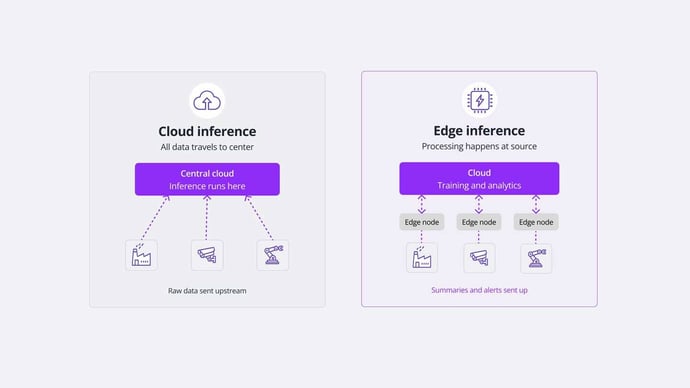
    The edge vs. cloud decision is a workload classification problem, not a technology preference. Five factors determine placement: latency tolerance, data volume, compliance requirements, resilience needs and infrastructure cost. Misallocation in either direction carries measurable consequences, defaulting to cloud accumulates latency debt and egress costs at scale, while premature edge investment introduces operational complexity before the business case is established. Organisational readiness is an independent variable that shapes when edge adoption is viable, separate from whether it is technically warranted.
  • Faster Compliance, Fewer Errors: A RegTech Framework for Reporting Automation
    Alex Marciuc - 7 Aug 2025
    Regulatory reporting has become one of the most resource-intensive functions in compliance, and one of the least scalable when managed through legacy processes. Across our work with RegTech teams, we consistently see the same challenge surface: compliance leaders are being asked to do more, faster, and with greater precision, but often without the tools or time to fundamentally rethink their approach.
  • AI Agents Promise Scale, But Most Teams Will Miss The Mark
    Ilie Ghiciuc - 10 Jul 2025
    Gartner names it 2025’s top AI trend, but only teams with scope, governance, and value metrics will succeed. Picture an invoice-scanning bot that doesn’t just flag anomalies—it renegotiates payment terms, logs the change in SAP and emails the supplier before finance gets its first coffee. That leap from “copilot” to fully autonomous colleague is what Gartner dubs Agentic AI, the top strategic technology trend for 2025.
  • How Foundation Models Are Redefining Lean Prototyping for Tech Startups
    Tudor Iordache - 12 May 2025
    Startups are under pressure to move fast and prove value early. Investors want to see working demos before they commit. Users expect polished experiences even in beta. And founders, often working with lean teams and tight budgets, need to bridge the gap between idea and execution without burning through their runway. This is where foundation models come in. These large-scale AI systems, pre-trained on diverse data and capable of handling language, image, and multimodal tasks, dramatically lower the technical barriers to building a prototype.
  • From Prompts to Prototypes: Using AI Tools to Accelerate MVPs
    Tudor Iordache - 7 May 2025
    Product teams are no longer starting with a blank canvas. Instead, they’re entering a landscape already populated by intelligent agents that can autonomously build interfaces, test logic, scan competitors, and extract signals from user noise. The implications are profound: AI isn’t just accelerating delivery; it’s shifting the product function from execution to strategy.
  • Enterprise DevOps Playbook: Driving Speed and Quality in Corporate Product Teams
    Tudor Iordache - 28 Apr 2025
    Innovation teams within large enterprises face a paradox. Tasked with driving change, they are often slowed by the very systems they aim to improve—rigid processes, siloed functions, and layers of approvals that hinder rapid experimentation. Unlike startups, where agility is built into the culture, corporate product teams must navigate complexity while still delivering at speed. This is where DevOps becomes essential. More than just a set of tools, DevOps is a cultural and operational framework that enables faster, more reliable software delivery. By integrating development and operations, teams gain the autonomy to deploy frequently, respond to feedback quickly, and maintain product stability—all without compromising enterprise-level governance or security.
  • Tudor Iordache - 14 Apr 2025
    Legacy systems, once the backbone of digital growth, now increasingly act as bottlenecks. Their tightly coupled architectures slow down releases, complicate integrations, and limit scalability, placing enterprises at a disadvantage in markets that demand speed and adaptability. Microservices have emerged as the new standard for building resilient, modular, and scalable digital products. In fact, for most of our client engagements in recent years, microservices have been the default architectural choice.
  • edge computing
    Tudor Iordache - 26 Sep 2024
    Edge computing addresses a structural limitation of centralized cloud architecture: as the volume of connected devices and the demands of real-time AI grow, routing all data through distant data centers introduces latency, bandwidth costs and compliance risk that certain applications cannot absorb. The model's value is not uniform across industries or use cases; it is most consequential where response time, data residency or operational continuity are non-negotiable constraints. The convergence of edge infrastructure with AI inference is the most significant recent development, shifting the economics of AI deployment by enabling model execution closer to the data source rather than in centralized compute environments. Most mature deployments combine edge and cloud in hybrid architectures, with workload characteristics determining placement rather than a preference for one model over the other. The infrastructure decisions organizations make now will shape what AI-driven and real-time applications can feasibly be built and operated at scale over the next several years. The way data moves through digital infrastructure is changing. For years, the dominant model was straightforward: devices collect data, send it to a centralized cloud, wait for a response. That model worked well enough when the volume of connected devices was manageable and when milliseconds of latency were acceptable. Neither of those conditions holds today.

RESOURCES

Unlock Knowledge and Inspiration with Our Ebooks

what-investors-look-for-resources

What Investors Look for Before Investing in Your Startup

Find out more ->

pitching-your-startup-ebook-resources

How To Pitch Your Startup - Powered By Product Design

Find out more ->

The Essential Role Of Trust In Product Development 4

The Essential Role Of Trust In Product Development

Find out more ->