Turning an idea into a market-ready product runs through four stages: validation, a product design phase, the build and a first release. The expensive mistakes tend to happen at the handoffs between stages, where evidence turns into opinion, the reasons behind decisions stay with whoever was in the room and a first release ships without a way to test its central bet. A market-ready product is one a customer can find, buy, set up and get help with without the founder present, which asks far more of it than an MVP does.
Most advice on turning an idea into a product concentrates on two moments. One is validation, where a founder tests whether the problem is real and worth paying to solve. The other is launch, where the product meets the market and the numbers start to mean something. Both deserve the attention they get, and both are well documented.
The stretch between them gets far less attention, even though it is where most of the budget gets spent. Between a validated idea and a product strangers can buy sit a design phase, a build and a first release, and each is usually run by different people working from documents the previous stage produced. Evidence gathered in twenty interviews reaches the design team as three bullet points. A scope agreed in workshops reaches developers as a backlog. A first release ships the features but not the means to tell whether its central bet paid off.
None of these losses looks like a mistake at the time. They show up later as rework in the build, as a launch that cannot answer its own question or as a product that works well in a demo and stalls once a customer has to set it up alone.
This article maps the four stages from idea to market-ready product, the handoff at the end of each one and what has to travel across it. It also sets out what separates a first release from a product that is ready for the market, which is a different finish line from the one most build plans aim at.
What a market-ready product is, and how it differs from an MVP
A market-ready product is one a customer outside the founding team's network can find, evaluate, buy, set up and get help with, without the founder in the room. An MVP has a narrower job: testing whether the core value holds, usually with early users who were recruited personally and tolerate gaps in exchange for a say in what comes next.
The distinction matters more each year, because buyers increasingly expect to get through a purchase on their own. A Gartner survey of 646 B2B buyers, run in August and September 2025, found that 67% prefer a buying experience without a sales rep. In a young company the founder is the rep, the onboarding guide and the support desk at once, so everything the founder does by hand around a first release is a list of jobs the product will eventually have to do alone.
A build plan aimed at an MVP finishes when the core journey works. A plan aimed at the market finishes when a stranger can complete that journey unaided.
The four stages from idea to market-ready product
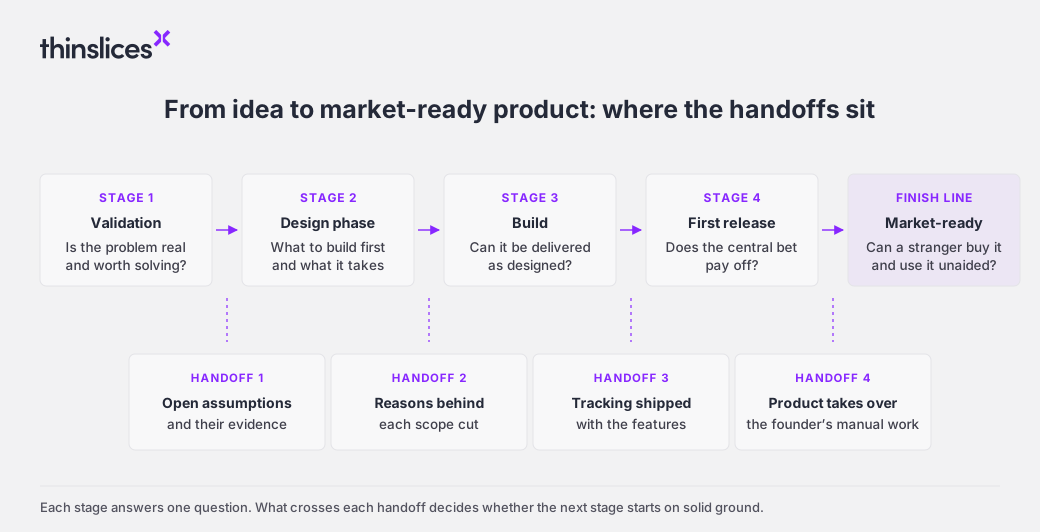
Each stage answers one question, and its exit test is whether that answer is solid enough for the next stage to start without reopening it.
Validation asks whether the problem is real and worth solving for a specific group of people. It ends with evidence rather than enthusiasm, a sequence set out in 7 steps to validate a product idea before you build.
A product design phase asks what to build first, how it will be built and what it will take. It ends with a scope a development team can estimate and start on, the argument of why a product design phase comes before the build budget.
The build asks whether the scoped product can be delivered as designed. It ends with a first release running under real conditions, ideally with the riskiest technical work done in the early sprints.
The first release asks whether the central bet pays off with real users. It ends with an answer to the one assumption it was designed to test, and with an honest list of everything the team still does by hand.
When the first three stages run with the same partner, as in our Idea to MVP engagements, some of the handoffs below get shorter. None of them disappears.
Where the expensive mistakes happen: four handoffs
A team can run every stage well and still end up with a product that drifted, because what one stage learns does not automatically reach the next.
1. Validation to design phase: evidence turns into opinion
Validation produces raw material: what people said, what they did, which assumptions survived. By the time it reaches a design team it is often a summary of conclusions, and a conclusion cannot be questioned the way a quote can. The design team then either asks again or builds on findings it cannot check.
What should cross this handoff is the open list rather than the verdict, meaning the assumptions still unconfirmed and the evidence behind those marked as settled. We log assumptions from the first day of a design phase, next to a problem statement the client has agreed, so the open questions from validation have somewhere to land. Kept current, that list is worth carrying through the build and into the first release.
2. Design phase to build: the reasons stay in the room
A scope records what was decided far better than why. The reasons behind a cut feature, a rejected integration approach or the point where release one stops usually live in conversations, and when the build team is not the team that ran the design phase, those reasons go missing first. Decisions then get reopened in the early sprints because nobody present can say why they were made.
We brief the development team in person and hold the first release to an explicit definition of ready for development, both covered in what you get at the end of a product design phase. One addition is worth asking for: a short decision log, each scope cut with one line on why. A developer who joins in month three can then see the reasoning without the meeting.
3. Build to first release: the features ship, the test does not
We scope release one to deliver real value while validating the most important assumption, and which risks it should carry is covered in how to reduce risk before committing to a full product build. What tends to slip at this handoff is the measurement. A release meant to show whether customers finish onboarding, return in week two or upgrade needs that behaviour tracked from the day it goes live, since analytics added later can only describe the users who arrive after them. The tracking belongs in the release scope, estimated in the feature breakdown like any other item.
4. First release to market: early adopters forgive what buyers will not
Early users are usually people the founder recruited and who have a direct line to the team. They work around missing pieces because they want the product to exist. Buyers who find it on their own have no such reason, so the gaps early adopters absorbed quietly become reasons to leave or not to buy. At this handoff the product has to take over the work the founder has been doing by hand.
What a first release still needs before it is market-ready
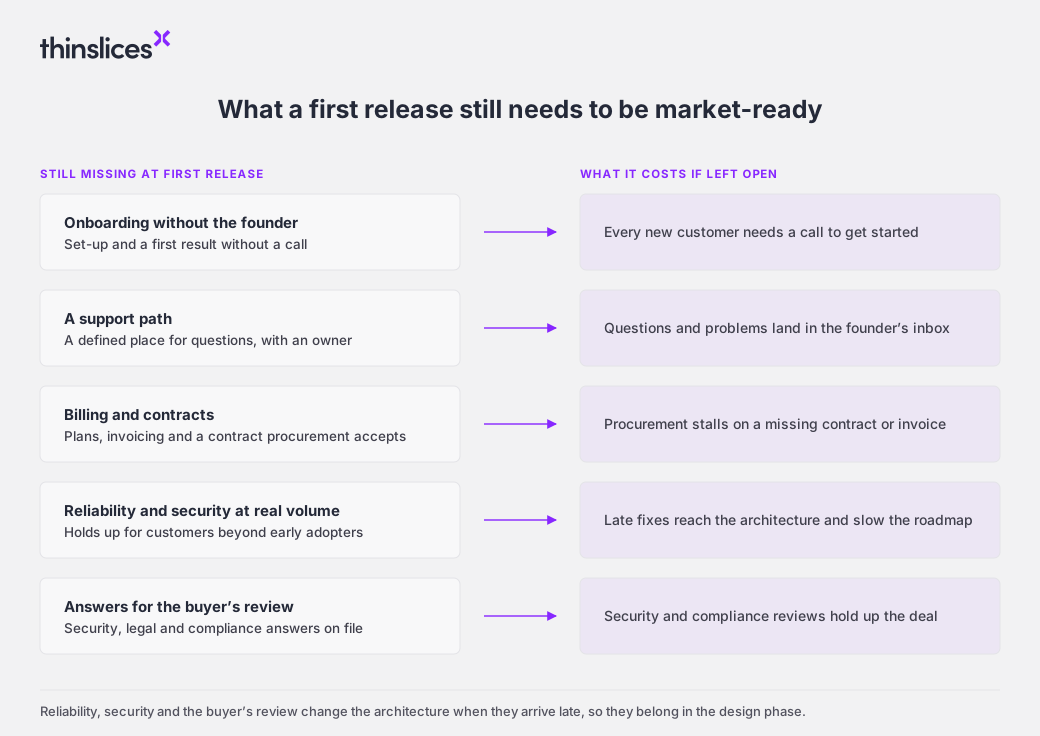
The gap between a working first release and a market-ready product is mostly made of things nobody tested in validation and nobody demoed in the design phase. Five come up most often:
- Onboarding without the founder. A new customer can set up the product, connect their data and reach a first useful result without a call.
- A support path. There is a defined place for questions and problems, and someone owns the response.
- Billing and contracts. Plans, invoicing, upgrades and the contract a procurement team will ask for exist outside a spreadsheet.
- Reliability and security at real volume. The product holds up under the load and access patterns of customers who are not early adopters.
- Answers for the buyer's review. What a buyer's security, legal or compliance team will ask is written down before they ask it.
The last two change the architecture when they arrive late. Performance, security and scalability shape how a product is built, which is why we define them as part of the technical architecture in a design phase instead of leaving them for launch week.
The review side is often heavier than founders expect. In Vanta's State of Trust 2025 survey of 3,500 business and IT leaders, teams reported spending nine working weeks a year on vendor security reviews and risk assessments, up from seven the year before. Vanta sells compliance software, so treat the figure as directional; it still shows how much work waits on the buyer's side of a sale that an MVP never had to pass.
What this sequence cannot guarantee
Clean handoffs do not guarantee a product the market wants. They change how early a team finds out and whether it still has room to act. The stages also overlap more than any diagram suggests, and the build changes some of what the design phase decided. We present the output of a design phase as a well-researched plan rather than a guarantee, because estimates evolve during development and priorities move with the market. Product-market fit sits outside the sequence altogether, and a market-ready product keeps having to earn it after launch.
Where to start: one question for each handoff
Wherever a product sits today, the next handoff is the one worth checking.
- Validation to design phase: which assumptions are still open, and where is the evidence for those marked as confirmed?
- Design phase to build: could a developer who missed every session explain why the first release stops where it does?
- Build to first release: which assumption is this release testing, and is the behaviour that answers it tracked from day one?
- First release to market: what does the founder still do by hand for every new customer?
A question nobody can answer quickly marks the handoff to fix first.
What survives the handoffs is the product
A product that reaches the market is the sum of whatever made it across each handoff. The interviews, the trade-offs, the reasons a feature was cut and the bet the first release was built to test all exist at some point. Whether they reach the next team depends on someone treating the handoff as work in its own right, and that work rarely appears in a plan because it never shows up as a milestone.