Product design and UI/UX design are not the same service. UI/UX design is the craft of the interface: information architecture, user flows, visual direction, design system foundations. Product design in software development is the phase that runs before a build and decides what gets built, whether it is technically feasible and what it will cost. It is delivered by a trio of product manager, UX designer and software development lead, and it ends in a validated, estimated, buildable scope rather than a set of screens.
Search for a product design agency and the results will mix two very different businesses. One builds websites and brand systems, and describes the interface work as product design. The other runs a structured phase before development, where a product manager, a designer and an engineer decide together what a software product should be, what it will cost to build, and whether the technology meets the requirements. Both use the phrase in good faith and describe real work, but a buyer comparing the two is not comparing like with like.
The confusion has a cost, and it usually lands on the buyer. A funded team about to commit its first serious engineering budget can end up commissioning a set of screens when what it needed was a validated and estimated scope, then discover halfway through development that the integrations were never priced and the feature list was never sequenced. The reverse is less painful but still wasteful. A team that wants a defined set of screens reworked, with the architecture settled and the release already planned, does not need a discovery phase to get there, and paying for one delays the work it actually came for.
The distribution is the part worth knowing. A peer-reviewed study collected data on 5,392 IT projects and compared estimated and actual costs for the 4,677 that had both figures (Flyvbjerg et al., 2022). The median came in on budget, overruns and underruns were about equally common and the average still landed at 1.8 times the estimate because a minority of projects overran by multiples. The risk in commissioning a build is not that it costs somewhat more than planned. It is landing in the tail.
The paper attributes that tail to interdependencies among technical components rather than to anything related to scope. What we see putting a project there is rarely something nobody could have seen. It is usually a question that was askable at the start and got asked in month five.
None of this is a semantic argument. The label decides who sits in the room, what exists at the end of the engagement and whether a development team can begin without a list of unanswered questions.
What product design means in software development
Product design in software development is a short, intensive phase that moves a product from a problem space to a scope a development team can build against. It sits between the decision to invest and the first line of production code, and it exists to surface ambiguity while it is still cheap, rather than during the build when it is not.
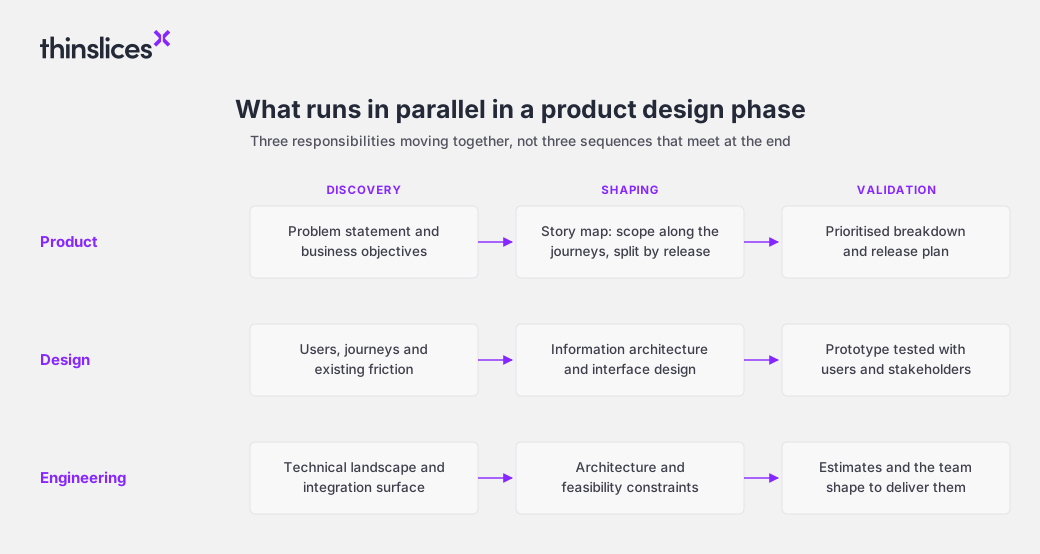
Three people carry the work, each holding a different piece of it: the product manager owns scope, priorities and client alignment; the UX designer owns the experience, the information architecture and the visual direction; the software development lead owns architecture, feasibility and estimates. They work in the same room rather than as three streams that converge at the end. That is what catches a design decision that carries an unpleasant technical cost, even though it can still be changed for free.
What comes out is a set of artefacts, not an impression:
- a high-level requirements document, three to seven pages, that serves as the single source of truth,
- the user persona the product is addressed to,
- information architecture and user flows,
- a user story map, with scope organised along the journeys and grouped into releases by priority,
- design system foundations where the product needs them,
- a clickable prototype,
- technical architecture documentation, covering stack, integrations and identified risks,
- a prioritised feature breakdown with development estimates attached,
- non-functional requirements,
- a recommended team composition for the build, covering roles, seniority and allocation,
- a release plan.
The story map is the artefact that does the most work. It puts the scope along the user journeys and groups it into releases, which is what makes a trade-off tangible: move a story into the second release and you can see what the first release feels like to use. A feature breakdown usually takes its structure from the map, and the estimate follows the breakdown.
The last five items are what most clearly separate this from interface work. Estimates on their own do not give anyone a date, because a range of effort only becomes a timeline once you know what team is delivering it. A feature breakdown with estimates attached turns scoping from an instinct into an argument, and an argument can be checked.
What UI/UX design covers, and where it sits inside product design
UI/UX design is the discipline of the interface and the experience of moving through it. It covers information architecture, user flows, interaction patterns, visual identity where the product needs one and the design system foundations that keep a product coherent as it grows. The information architecture, the user flows, the design system foundations and the prototype in the list above are all the UX designer's work, so calling this a component of product design is a statement about remit, not about depth.
The difference is what the engagement is accountable for. A UI/UX engagement answers how the product should look and behave. A product design phase answers that as well, then keeps going: whether the behaviour is buildable on the existing architecture, what it costs, what has to ship first and what the product has to do that no screen ever shows, such as performance under load, accessibility standards and regulatory obligations.
There are cases where the narrower service is the correct purchase. A company with a mature product, an agreed roadmap and an engineering team that already knows what is feasible does not need a third party to re-derive its scope. What it needs is design work, and sometimes what it needs is a design system built to hold up across a large product estate.
Product design before a single screen: a digital-asset operations company
A digital-asset operations company came to us running its entire operations function on two disconnected systems: an Excel ledger as the record of truth, and on-chain transactions executed separately and by hand. Every recurring payment was manual, and nothing automatically reconciled the ledger with what happened on-chain. Reconciliation, approvals and reporting all depended on people copying information between two systems carefully enough not to break anything.
We did not start by designing screens. We mapped the existing flows end to end first, then defined what the ideal flow should be, and only then designed an interface for it.
What we defined was a platform that does the job core banking software does in traditional finance, built for on-chain operations: automated recurring transactions, a counterparty address book, penny tests and security checks within the payment flow, and month-end submission. Above that sat an analytics layer covering inbound and outbound volumes and the business's health, so that operators and leadership would read the same numbers. An AI layer connected to the company's own documentation, risk frameworks and business rules would let payments be validated against an agreed source instead of by guesswork.
The sprint produced personas, wireframes, and a working prototype; a technical proposal covering the stack, infrastructure, and architecture; a product roadmap; and a feature breakdown with the attached estimate. Not the full set above. A product with no existing users and no legacy estate needs less design system work and no migration planning. What it did produce was enough for a development team to start from without a second discovery phase.
The test: does the design work come back with an estimate attached
There is a quick way to tell which service is being sold. Ask whether the design work will include an engineering estimate and who produced it.
If the answer is that estimates come later, once a development partner has been selected and has had time to review the designs, then what is on the table is interface work. That can be exactly the right purchase. It does mean feasibility gets assessed after the decisions are made, by people who were not in the room when they were made, and the outcome we see most often is a rescope or a number nobody budgeted for.
If the answer is that an engineer sat in on the design sessions and the feature breakdown reflects their numbers, then feasibility was a live constraint rather than a later verdict. Designs that could not be built economically got caught while they were still cheap sketches.
In most of the engagements we see, design runs ahead and engineering reviews at the end. There is nothing scandalous about that arrangement. It simply relocates the cost of being wrong to the most expensive point in the project. McKinsey's design index study tracked 300 listed companies over five years and found the companies that said they had integrated designers with other functions clustered at the top of its financial ranking. The finding is correlational, the scoring instrument is McKinsey's own, the integration claim is self-reported and none of the three industries studied were software. With all of that conceded, it is still the closest thing to outside evidence that where design sits in a company matters as much as how good the design is.
There is a better objection to all of this than the sequential one, and it is worth stating. A team can skip the phase, build a thin slice, ship it and derive the estimate from measured velocity rather than from a document. Where that works, it beats any amount of planning, because a working increment is evidence and a feature breakdown is a forecast. It stops working when the first slice cannot be shipped to anyone: a regulated product whose compliance surface must be defined before launch, an integration that must be negotiated before it can be tested, a rewrite of something already live and already carrying users. A design phase earns its place when the cheaper way to learn is not yet available.
One more objection is worth answering, because it comes from the same research quoted at the top of this article. Flyvbjerg's advice to anyone commissioning a build is not to trust a bottom-up estimate at all. Add up the parts and the total comes out optimistic, reliably, partly because the people adding them up are usually the people who want the work. His alternative is to start from what comparable projects actually cost, and adjust from there.
That lands on any estimate produced by a firm that would also like to build the thing, ours included. The honest answer is not that our arithmetic is better. It is that the two methods answer different questions. Comparing against past projects tells you whether a number is plausible. A feature breakdown tells you what you would cut if it is not. Anyone commissioning a build wants both and should ask whoever is quoting them how their last few estimates compared to the actuals.
What teams underestimate when they buy UI/UX instead of product design
The gap between the two services tends to show up in four places, usually after the contract is signed.
1. Technical assumptions stay open when no engineer is in the design phase
A prototype can be approved by everyone in the room and still rest on an integration nobody has tested, a data model that does not exist yet or a third-party service whose rate limit breaks the intended flow. None of that is a design failure. It is not what a design review is looking at, so it surfaces during development as rework instead of during design as a decision. Boehm and Basili put the cost of fixing a problem after delivery at 100 times what it costs during requirements and design, and they are careful to note that the multiple is closer to 5 for small, non-critical systems. Either end of that range argues for asking the question earlier.
2. A complete screen set does not define a first release
A finished set of screens describes a finished product. It says nothing about which parts should ship first, and a development team handed all of it at once will either sequence the work themselves or pass the question back to the client. Deciding what not to build is the harder half of scoping, and it does not happen by looking at screens.
3. Nobody owns the trade-off between the ideal experience and the delivery timeline
Every project reaches a point where the better experience costs more time than the schedule has. Someone has to decide what gives. Without a product manager and an engineer accountable for the same phase, that decision falls to whoever is under the most pressure, which tends to be the development team, late.
4. Non-functional requirements go unwritten until they are expensive
Performance targets, accessibility standards, security and compliance obligations, offline behaviour, error states at scale. None of them are visible in an interface; all of them are expensive to retrofit, and in a regulated product they are not optional.
How long a product design phase takes, and what shapes the timeline
The honest answer is that it depends on the product, and the variables are not evenly weighted.
Domain complexity is the heaviest. A consumer utility with a handful of flows and a publishing platform with role-based permissions, an editorial workflow and legacy data to preserve are not the same problem, and no process compresses the second into the shape of the first. Regulation adds weight, since products in finance or health spend real time on obligations a non-regulated product never meets. So does stakeholder count, because every additional approver adds a validation cycle. A team arriving with user research and a clear problem statement needs less discovery and more shaping.
Our own phases have generally run four to six weeks, with four as the baseline. That is a description of the engagements we have run, not a formula to apply. A phase scoped to a calendar rather than to the product produces confident answers to the wrong questions.
Cost follows the same variables, because what is bought is the time of three specialists across the length of the phase, which is also true of how a build gets estimated.
Choosing between product design and UI/UX design
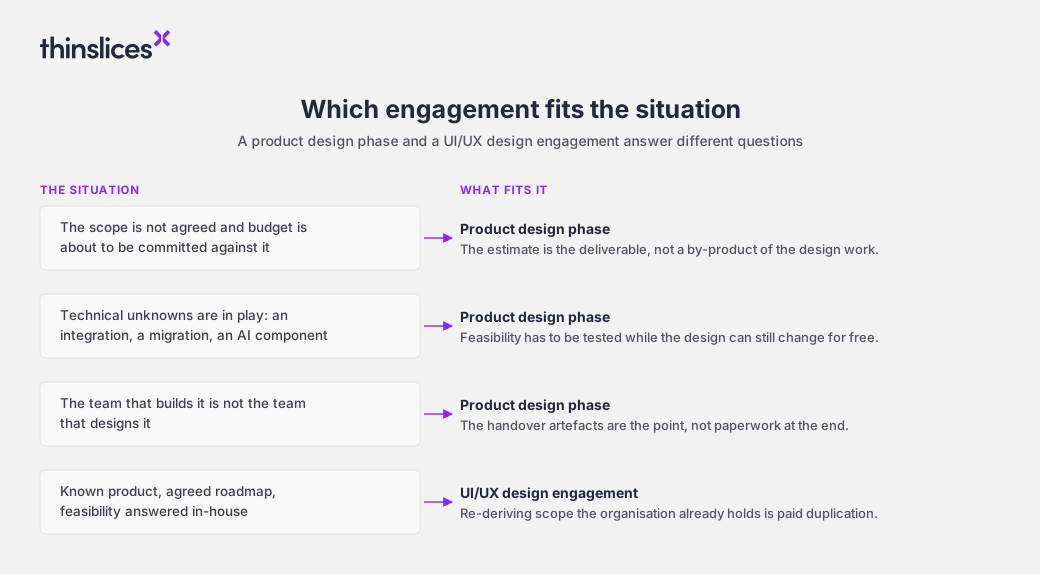
Three conditions point to a full product design phase. The scope is not yet agreed and the estimate matters, because budget is about to be committed against it. The product carries technical unknowns, whether an integration, a migration or an AI component whose behaviour has to be validated before anything can be designed around it. Or the people who will build it are not the people designing it, which makes the handover artefacts the entire point.
A UI/UX engagement is the better purchase when none of those hold. A known product, an agreed roadmap, an engineering team that can answer feasibility questions in-house and a specific experience problem worth solving properly. Buying the larger phase in that situation means paying to re-derive what the organisation already knows.
Buying the wrong one rarely announces itself at the time. It shows up later, as a delay nobody planned for or a rewrite that was avoidable, and by then the cheap moment to have asked has gone.
Frequently asked questions
Is product design the same as UI/UX design?
No. UI/UX design is the craft of the interface and the flows through it. Product design in software development is the phase that produces a validated, estimated and buildable scope, of which the interface work is one part. A UI/UX engagement can be delivered by a designer working alone. A product design phase cannot.
Do you still need product design if you already have designs?
Sometimes, and the test is what the designs are missing rather than how good they are. If there is no prioritised feature breakdown, no engineering estimate and no written non-functional requirements, a development team will have to produce those before it can start. Producing them alongside the design costs less than producing them afterward.
Who is in a product design team?
A product manager, a UX designer and a software development lead, working as one team rather than in sequence. The product manager owns scope and priorities, the designer owns the experience and the information architecture, the engineer owns architecture, feasibility and estimates.
What do you get at the end of a product design phase?
A high-level requirements document, user personas, information architecture and user flows, a user story map, design system foundations, a clickable prototype, technical architecture documentation, a prioritised feature breakdown with development estimates, non-functional requirements, a recommended team composition for the build and a release plan.