A corporate MVP is a question rather than a small product, and in 2026 the expensive part of answering it is no longer the build. AI-assisted development made first versions fast to produce, while the path from a working version to something live got harder: 30% of attempts to merge changes into production now fail, the worst rate in over five years. Inside a large organisation, the MVP has to clear security review, data protection assessment, AI Act classification and platform integration before it reaches a user. Planning for that path, rather than for the build, is what separates a corporate pilot that ships from one that quietly expires.
Corporate innovation teams are not short of ideas, and since 2023 they are not short of ways to build them either. What they are short of is proof. A pilot that runs for two quarters and produces a demo, a deck and no decision is the most common outcome in corporate product work, and it is rarely the engineering that caused it.
This is the gap a minimum viable product is supposed to close. The idea is old and it has survived a great deal of fashionable criticism, most recently the suggestion that cheap AI-assisted building makes it obsolete. The opposite is closer to true. As Nielsen Norman Group put it when restating the definition in March 2026, "product risk is about the cost of being wrong, not the cost of development." Making the build cheaper does not make being wrong cheaper. It just removes the excuse for not finding out sooner.
What has changed is where the difficulty sits. This article covers what a corporate MVP is actually for, what AI-assisted development moved, the approval path an internal pilot now has to survive, and what the whole thing realistically costs in time.
What a corporate MVP is actually for
A corporate MVP is not a cheap version of the product. It is an instrument for retiring a specific risk, and the useful discipline is naming that risk out loud before anything gets built.
Most corporate pilots carry one of four:
- Demand risk. Will anyone use this, and will they use it enough to matter at our scale?
- Feasibility risk. Can this be built against our systems, our data and our latency requirements, rather than in a clean environment?
- Viability risk. Does the unit economics survive contact with our cost base, our margins and our compliance overhead?
- Organisational risk. Will the business actually adopt it? This one is specific to corporates and it is the most frequently ignored.
The version that gets built should be the smallest thing that settles whichever of those is most likely to kill the initiative. A pilot that produces a polished interface while leaving the integration question open has answered the cheap question and left the expensive one standing.
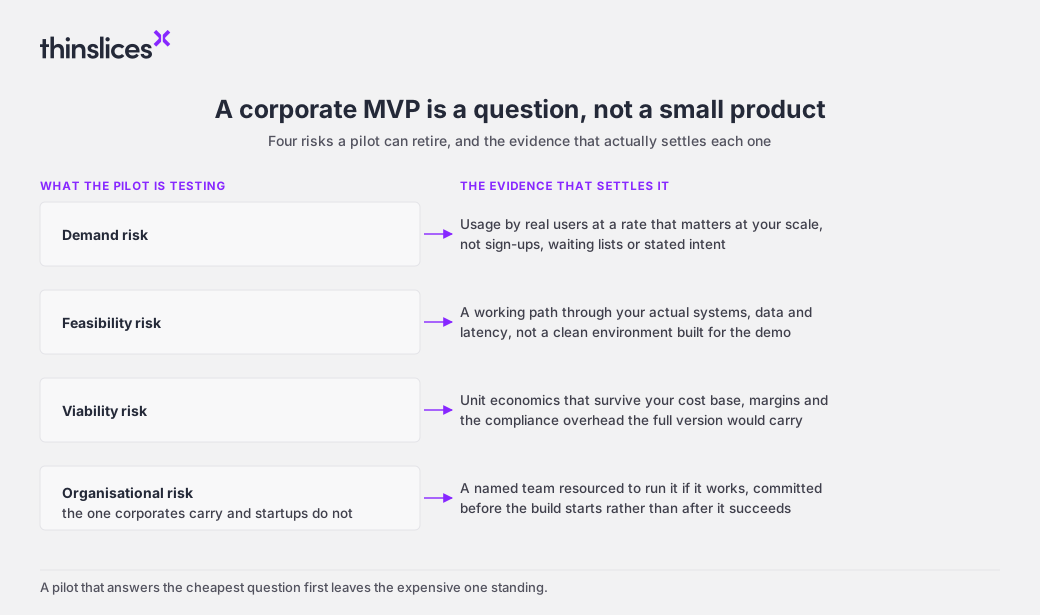
Naming the risk first is what stops a pilot producing a demo instead of a decision.
Corporates have real advantages here that startups do not: an existing customer base to test against, internal data, distribution and brand permission. They also carry constraints a startup does not, and the constraints are the part that gets underestimated. Deciding what not to build is usually the higher-value decision, which is covered in more depth in deciding what not to build, and when to rescope or freeze and in build the right first version by mastering MVP scoping.
What changed: building the first version stopped being the hard part
The economics of getting to a working version have shifted, and the shift is not evenly distributed.
CircleCI's 2026 State of Software Delivery, which analysed 28,738,317 workflows, found average throughput up 59% year on year, "reflecting a sharp rise in AI-driven code generation." On the main branch, throughput went the other way, down 7%. Merge success rates fell to 70.8%, their lowest in over five years, meaning roughly 30% of attempts to move changes into production code now fail. Their summary is worth quoting directly: "Fewer than 1 in 20 teams are currently able to absorb AI-driven acceleration without slowing down their delivery pipelines."
That is the shape of the problem. Producing candidate work got dramatically faster. Absorbing it did not.
The maintainability picture points the same way. GitClear's analysis of 623 million changes found refactoring dropped to 3.8% of changed lines in 2026, from around 21% in 2022, while copy-paste rose from 9.4% to 15.7%. Fast first versions are being built on foundations that are getting harder to extend, which matters enormously for an MVP whose entire purpose is to become something else if it works.
For a corporate team the practical consequence is a planning error, not a technology problem. Teams still budget most of the timeline for building and treat review, integration and hardening as a tail. The tail is now the body of the work. Two related pieces cover the engineering side of this: lessons on designing an AI software development workflow and why code quality still matters in the era of AI.
There is also a scale problem behind the pilot problem. McKinsey's state of AI survey, covering 1,993 respondents, found 88% reporting regular AI use in at least one function, roughly a third having begun to scale, and 39% attributing any EBIT impact at all, most of them under 5%. Pilots are not scarce. Pilots that turn into something are.
The approval path a corporate MVP has to survive
This is the part generic MVP advice cannot help with, and it is where corporate timelines actually go.
An internal pilot inside a large organisation typically has to pass security review, a data protection assessment, procurement or vendor governance if anyone external is involved, platform and integration sign-off, and now, if there is any AI in it, a regulatory classification. Each of these has its own queue. Run consecutively they consume a quarter. Run in parallel from week one they consume far less, and the single most useful scheduling decision a corporate product lead makes is starting them early rather than at the point the build feels finished.
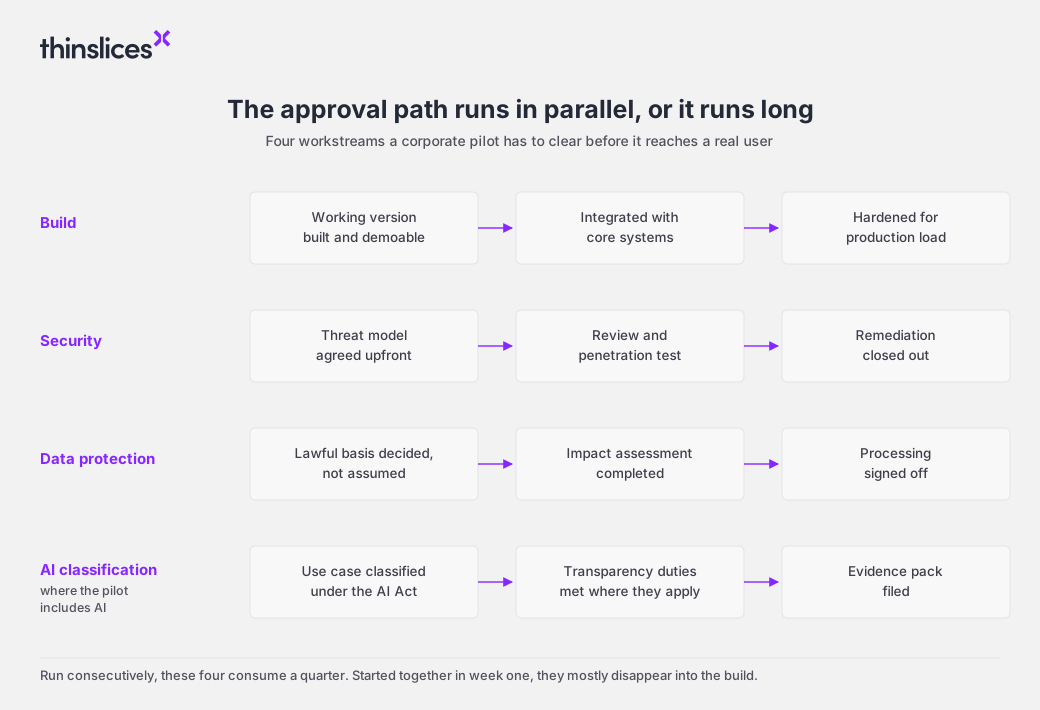
Most corporate pilots are planned as the top row alone. The other three are what actually set the launch date.
The AI Act position changed twice in the last year, and both changes matter. Transparency obligations under Article 50 have applied since 2 August 2026. If your pilot has a chatbot, generates synthetic content or does emotion recognition, it is in scope now, not later. Systems already on the market have until 2 December 2026 for machine-readable marking. Meanwhile the heavier high-risk regime was pushed back: Regulation (EU) 2026/1744, in force since 27 July 2026, moved the Annex III obligations covering employment, education, biometrics and critical infrastructure from August 2026 to 2 December 2027, and product-embedded high-risk to August 2028. Any internal guidance written against the old August 2026 cliff edge is now wrong in both directions, too strict on high-risk and too relaxed on transparency.
There is a sanctioned route for testing, and it is mostly theoretical so far. Article 57 requires every member state to run an AI regulatory sandbox, a deadline the omnibus moved to 2 August 2027, and Article 57(12) protects good-faith participants from administrative fines. Article 60 permits testing in real world conditions outside a sandbox, capped at six months and extendable once, with registration in the EU database, and Article 61 requires informed consent with a right to withdraw and demand deletion. Worth knowing before planning around it: a European Parliament briefing in April 2026 found only Spain with an operational sandbox, five member states implementing and sixteen that had communicated nothing.
GDPR did not move, and it catches more pilots than the AI Act does. The broader omnibus amending GDPR remains a proposal. EDPB Opinion 28/2024 is still the operative guidance. The trap is mundane and common: using production customer data for an internal experiment is a new purpose, so it needs its own lawful basis and a compatibility assessment. "It was only a pilot" is not a defence, and discovering this at review is what turns a six week build into a five month project.
One more date, close at hand. Cyber Resilience Act incident reporting starts on 11 September 2026 for products with digital elements placed on the EU market, with a 24 hour early warning and a 72 hour notification. If the pilot is intended to reach real users in the EU, that obligation belongs in the plan rather than in the retrospective.
Where corporate MVPs actually fail
The failure modes are consistent, and none of them are engineering.
The pilot has no kill criteria. If nobody agreed in advance what result would end the initiative, it will not end. It will be extended, rescoped and eventually defunded without ever producing a decision. Writing down the number that means stop, before launch, is the cheapest governance available.
Success is measured in delivery rather than learning. A pilot judged on whether it shipped on time will always be reported as a success, which tells the business nothing. The question is whether the risk it was built to retire actually got retired.
Nobody owns adoption. Organisational risk is the one corporates carry and startups do not, and it is routinely left off the risk list. A validated product that no internal team is resourced to run is not a validated product. Securing that commitment early is a separate exercise, covered in strategies to secure internal buy-in for corporate innovation projects.
The integration question is deferred. Building against a clean environment and leaving the connection to core systems for later answers the easy question first. In most corporate settings the integration is the feasibility risk, so deferring it means the pilot proves nothing that was in doubt.
The business case arrives after the build. By then the framing is defensive. It works considerably better in the other order, which is the argument in how to build a business case for AI before writing a line of code and in how to build a business case for corporate innovation.
A first version built inside a regulatory constraint
Monzo is a useful illustration precisely because it was not free to build whatever it wanted.
Before it held a banking licence, it could not offer a current account. So it launched, as Mondo, with a prepaid Mastercard: a deliberately limited product that let real customers move real money while the licence application progressed. The company documented the sequence publicly, from the prepaid launch in October 2015, through a restricted banking licence in August 2016, to a full licence in April 2017, and finally closing the prepaid cards in 2018 once the accounts they were standing in for existed.
The transferable part is not the fintech specifics. It is that the constraint shaped the scope rather than delaying the start. A regulated corporate team facing an eighteen month approval path has the same choice: wait for permission to build the real thing, or find the version that can legally run now and learn from it in the meantime. The prepaid card was never the product. It was the question, asked in the only form that was available at the time.
What a corporate MVP costs, and how long it takes
The honest answer is that it depends, so here is what it depends on.
The build is now the smaller share of the timeline. For most corporate pilots, expect the internal path, security review, data protection assessment, integration sign-off and any AI classification, to take at least as long as the development, and often longer. The controllable variable is whether those run in parallel with the build or after it. Teams that sequence them consecutively routinely lose a quarter that was never in the plan.
Discovery is the cheapest place to spend. A short structured engagement before committing to delivery, whether that is a design sprint or a validation sprint, is the least expensive diligence available, because it surfaces the integration and stakeholder problems while changing direction is still free. Our Product Validation Sprint exists for exactly this, aligning stakeholders and defining must-have scope before the build budget is committed. The related question of how much design belongs in front of the build is covered in why a product design phase comes before the build budget.
Budget for the version after the MVP. The most common financial error in corporate pilots is funding the pilot and not the decision that follows it. If the MVP succeeds, something has to be resourced to run it, and if that money does not exist, the pilot was always going to be shelved regardless of its result. For the mechanics of estimating the build itself, see how much will my MVP cost?.
Corporate appetite for this work has not gone away, whatever the innovation-lab obituaries suggest. Global Corporate Venturing recorded 5,038 corporate-backed deals in 2025 worth $229 billion, up 75% year on year, with roughly one in five startup funding rounds now including a corporate investor. The money is there. The constraint is evidence.
Frequently asked questions about corporate MVP development
What is a corporate MVP?
The smallest version of a product that settles a specific business risk under real conditions, built inside an existing organisation rather than a startup. It differs from a startup MVP mainly in what surrounds it: existing systems to integrate with, internal stakeholders to satisfy, compliance obligations to clear and an adoption question about whether the business will actually run the thing if it works.
How long does a corporate MVP take?
Longer than the build estimate, and the gap is the internal approval path rather than the engineering. Security review, data protection assessment, integration sign-off and AI classification each have their own queue. Run in parallel with development they add little. Run afterwards they can double the timeline.
Does the EU AI Act apply to an internal pilot?
If the pilot involves AI, yes, though which parts apply depends on the use case. Transparency obligations under Article 50 have applied since 2 August 2026, so a pilot with a chatbot or synthetic content generation is in scope now. High-risk obligations were deferred to 2 December 2027 by Regulation (EU) 2026/1744. Articles 57, 60 and 61 provide sanctioned routes for sandboxed and real-world testing, though national sandboxes are not yet widely operational.
Can we use real customer data to test an MVP?
Not automatically. Using production customer data for an internal experiment is a new processing purpose under GDPR, requiring its own lawful basis and a compatibility assessment. EDPB Opinion 28/2024 remains the operative guidance. This is one of the most common causes of a pilot stalling at review, and it is entirely avoidable by asking the question in week one.
Has AI made the MVP obsolete?
No. It made building the first version cheaper, which changes the cost of finding out, not the cost of being wrong. If anything the case for deliberate validation is stronger, because the volume of things that can be built quickly has risen faster than any organisation's ability to review, integrate and support them.
The point of building the smallest thing
A corporate MVP earns its place when it produces a decision. Not a demo, not a deck and not a set of learnings that everyone agrees were valuable and nobody acts on.
What has changed in the last two years is which part of that is hard. Building a working version is no longer the constraint for most teams. Getting that version through review, into the estate and in front of real users, with the evidence to justify what happens next, is where corporate pilots are won and lost.
Which makes the first question worth asking not "what should we build" but "what would we have to see to commit, and what is the smallest thing that would show us".