Tudor Iordache

Insights by Tudor Iordache

### Tudor Iordache **Chief Technology Officer at Thinslices** As the CTO at Thinslices, I've had the privilege of leading our talented team in delivering hundreds of innovative digital products. Over my 11 years here, I've grown from an iOS intern to various roles including iOS Developer, Lead Software Engineer, and Technical Lead. My expertise in SwiftUI and Flutter, combined with my passion for technology, has enabled me to drive our projects to success and ensure we meet our high standards of quality and innovation. Every project is a story waiting to be written. I like to think that I can contribute to the development of the characters involved and the plot of it. I’m still trying to figure out what’s the recipe to create a best-seller, but with every project passing I feel like I’m closer to the answer.
  • Six principles for AI systems that work in production
    Tudor Iordache - 2 Jul 2026
    The AI projects that work in production share a small number of structural decisions. None of them is about the model. All of them are about the system around the model: the threshold defined before the build begins, the constraint treated as architecture rather than an obstacle, the surface designed as the actual product, the MVP scoped as the first instance of the platform, the human kept in the loop as a permanent feature rather than a transitional one. The discipline of building AI well is the discipline of getting these decisions right early enough for the model to do its job, and of refusing to defer them until the cost of deferral becomes unavoidable.
  • Human-in-the-loop AI systems where judgement stays in the workflow
    Tudor Iordache - 24 Jun 2026
    Human-in-the-loop is not the version of AI you build while waiting for the model to get good enough to replace the human. It is the version of AI that actually works in domains where being wrong is expensive. The teams treating it as a transitional design are building systems that will eventually be replaced. The teams treating it as the destination are building systems that compound trust and improve over time.
  • How do you build RAG systems that work in production?
    Stefan Sarbu - 18 Jun 2026
    Most RAG implementations are built to produce answers. The ones that work in high-stakes environments are built to produce answers with calibrated confidence, source attribution the user can verify, and behavior that changes when confidence is low. The hard engineering work sits in four places most teams underestimate: chunking strategy, embedding quality, confidence calibration, and how the system surfaces its own uncertainty. The teams that get RAG into production treat confidence as a product feature rather than a model property, and they treat "I do not know" as a legitimate answer the system needs to be trusted to give.
  • AI browser agents: the gap between demo and production
    Ilie Ghiciuc - 10 Jun 2026
    Browser-use AI agents are most valuable when they are a component in a larger system, not when they are deployed as a complete solution. The teams getting durable value treat the agent as a navigation layer feeding into deterministic downstream processes, with serious operational infrastructure around it. The teams that struggle deploy the agent and expect the rest of the system to follow.
  • Edge AI inference: what it means for your product architecture
    Ilie Ghiciuc - 2 Jun 2026
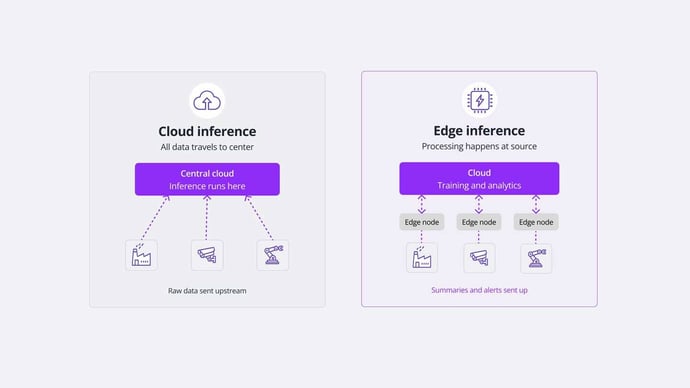
    AI inference is moving toward the edge because centralized cloud processing introduces latency, egress costs and data residency constraints that compound as inference volume scales. The decision of where to run inference is determined by five workload characteristics: latency tolerance, data volume, compliance requirements, operational resilience needs and cost profile over time. Most production architectures resolve this by splitting responsibilities between cloud and edge, with the operational overhead of managing a distributed inference fleet remaining the primary factor that determines when the transition is viable.
  • What Gartner's 2026 tech trends mean for product teams, not CIOs
    Tudor Iordache - 12 May 2026
    Of Gartner's ten 2026 technology trends, four matter disproportionately for product builders: AI-native development, multiagent systems, domain-specific language models, and digital trust. AI-assisted development works only when grounded in structured context, not clever prompts. Multiagent systems are already in 80% of enterprise apps shipped in Q1 2026, yet 88% of agent pilots never reach production, because the bottleneck is product design, not model quality. Domain-specific models outperform general ones for targeted use cases, but only when a pre-development business case has set accuracy and cost thresholds.
  • Edge computing vs. cloud computing: how to choose your architecture
    Tudor Iordache - 16 Apr 2026
    The edge vs. cloud decision is a workload classification problem, not a technology preference. Five factors determine placement: latency tolerance, data volume, compliance requirements, resilience needs and infrastructure cost. Misallocation in either direction carries measurable consequences, defaulting to cloud accumulates latency debt and egress costs at scale, while premature edge investment introduces operational complexity before the business case is established. Organisational readiness is an independent variable that shapes when edge adoption is viable, separate from whether it is technically warranted.
  • Best practices for embedding AI in SaaS Platforms
    Tudor Iordache - 9 Mar 2026
    Embedding AI in a SaaS platform is primarily a product and systems challenge rather than a modeling exercise. Effective implementations start by identifying specific workflow problems, validating AI capabilities through controlled experiments, and only then integrating them into platform architecture designed to support evolving models, data dependencies, and operational constraints. Reliable outcomes depend on structured data foundations, transparent human oversight in critical workflows, and clear ownership for monitoring and iteration after release. When these conditions are in place, AI capabilities can evolve as part of the product rather than remaining isolated experiments.

RESOURCES

Unlock Knowledge and Inspiration with Our Ebooks

what-investors-look-for-resources

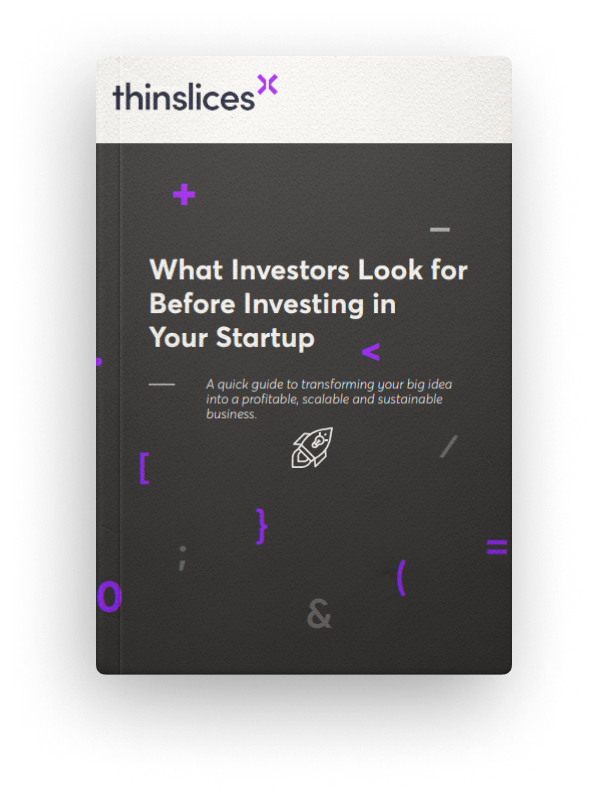
What Investors Look for Before Investing in Your Startup

Find out more ->

pitching-your-startup-ebook-resources

How To Pitch Your Startup - Powered By Product Design

Find out more ->

The Essential Role Of Trust In Product Development 4

The Essential Role Of Trust In Product Development

Find out more ->